
Choosing the right clay sand molding machine isn’t about picking the cheapest one on the list. The core is finding the machine that best matches your castings’ characteristics, your output requirements, and your workshop conditions. Here are a few key angles to help you sort it out:
Step 1: Draw a “Profile” of Your Castings
1. Size and Complexity of the Castings
This is the first major fork in the road for choosing equipment type:
Small, high-volume, simple castings (e.g., hardware parts, small agricultural machinery components): You can go straight for a jolt-squeeze molding machine (like the classic Z1410 series). It uses high-frequency, low-amplitude vibration combined with squeezing to densely pack the sand grains, filling gaps effectively. It handles simple to moderately complex molds well, has a straightforward structure, and is easy to operate.
Medium-to-large, complex castings with high surface finish requirements (e.g., automotive parts, engine blocks, valves): You’ll need a multi-piston (multi-touch) molding machine or an air-flow static pressure molding line. These use dozens of individual hydraulic heads that press down independently. Even if the pattern has big height differences, each head automatically adjusts pressure based on sand layer thickness. The resulting mold hardness is exceptionally uniform, typically averaging 85–90 on a B-scale hardness tester, and vertical walls also retain high hardness. This yields castings with smooth surfaces, high dimensional accuracy, and it saves sand.
2. Production Rate Requirements
A steady output of several dozen molds per hour: A standard jolt-squeeze or simple squeeze machine will suffice, ideal for small-to-medium batch sizes.
High-tempo production of 50–120 molds per hour: Look directly at multi-piston automatic molding lines or top-and-bottom shoot-squeeze dual-station fully automatic molding machines. The latter use air pressure to shoot and pre-compact the sand before the final squeeze—very efficient and highly automated.
Step 2: Decide Between Flask and Flaskless
These two routes have completely different implications for your workshop layout and tooling:
Flask Molding: The flask travels with the mold. It’s versatile, suitable for both small and large castings, and mold changes are relatively flexible. The multi-piston lines mentioned earlier are typically flask-type.
Flaskless (Boxless) Molding: After molding, the flask is stripped and recirculated. This is especially suited for extremely high-volume castings that aren’t huge (e.g., park benches, counterweights). Usually, the upper and lower molds are made in one machine, with molding and closing completed in a single cycle—very fast. For example, top-and-bottom shoot-squeeze flaskless machines like the Z5161 can cost between 50,000and75,000 USD, have around 15 kW of power, weigh about 11.5 tons, and can produce quite a few molds per hour.
Step 3: Focus on a Few Non-Negotiable Details
In equipment selection, the following points directly determine whether your daily operation will be smooth or a headache:
1. Compaction and Hardness Uniformity
If mold hardness is too low or uneven, you’ll get casting swell and excessive flash. Currently, the multi-piston internal force compaction technology is the most reliable route to solving uniformity issues—during pressing, the frame bears no reactive force; all force goes into the sand, guaranteeing both hardness and precision.
2. Automation and Ease of Use
Reliable modern machines are all PLC controlled. Also pay attention to: whether there are motion interlock protections, whether fault diagnostics are built-in, and whether remote monitoring is possible. A good machine lets new operators get up to speed independently in a few days, rather than relying on a handful of veteran masters forever.
3. Compatibility with Your Sand System
You need to communicate clearly with the equipment manufacturer about whether your existing green sand mix ratio, moisture content, and clay content might be sensitive for the new machine’s sand shooting ports and exhaust vents. High-performance multi-piston molding machines are generally not picky about sand, but some shoot-squeeze equipment has higher requirements for sand flowability.
Step 4: Factor After-Sales and On-Site Support into the Total Cost
A molding line is meant to run for over a decade. The supplier must be able to walk the entire journey with you:
Pre-sale: Do they offer a free site survey? Can they help optimize your layout and save you money on civil engineering modifications?
Mid-sale: How many days of training? Will they focus on sand preparation parameter adjustments? These are the keys to getting true value from the machine.
After-sales: Response time is a hard metric. A good manufacturer can respond to technical service calls within an hour and arrive on-site the same day. Core component availability and engineer deployment commitments need to be clearly written into the contract.
A Quick Reference to Match Your Situation
Budget-conscious, small castings → Jolt-squeeze molding machine (like Z1410 series), roughly a few thousand to twenty thousand USD. It’s capable and easy to maintain.
Efficiency-focused, moderate budget → Dual-station top-and-bottom shoot-squeeze fully automatic molding machine paired with a green sand preparation line. Easily churns out 700+ molds a day, requiring only 3–5 people to oversee.
High precision, large-batch complex castings → Static-pressure multi-piston molding line with an automatic pouring machine. The upfront investment is larger, but fast mold changes and a low scrap rate mean the volume of qualified castings you get will quickly offset the initial cost over time.
If you can share your casting material, maximum outline dimensions, target annual output, and a rough budget, I can help you narrow down the suitable machine range even further.
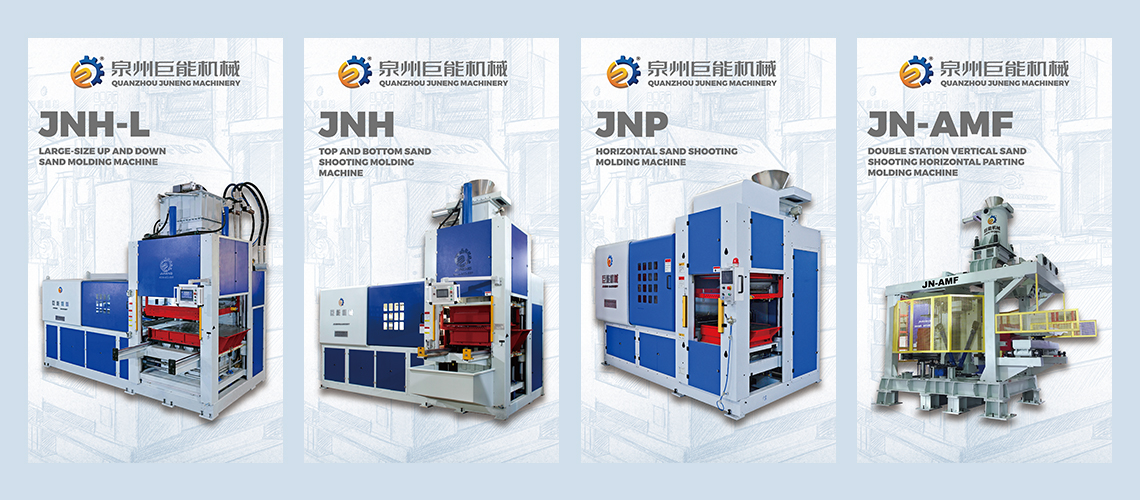
Quanzhou Juneng Machinery Co.,Ltd. is a subsidiary of Shengda Machinery Co.,Ltd. specializing in casting equipment.A high-tech R&D enterprise that has long been engaged in the development and production of casting equipment, automatic molding machines,and casting assembly lines.
If you need a Clay Sand Molding Machine, you can contact us through the following contact information:
Sales Manager : zoe
E-mail : zoe@junengmachine.com
Telephone : +86 13030998585
Post time: Jun-04-2026