
A flaskless molding machine and a clay sand molding machine are concepts on two different dimensions — they are not inherently parallel categories. A flaskless molding machine is a specific type of equipment, whereas clay sand molding refers to a process that uses clay-bonded sand as the molding material. What you are most likely trying to compare are the two main equipment routes for the clay sand process: the flaskless shoot-squeeze molding machine and the traditional flask molding machine (clay sand molding equipment) .
To help you understand the differences, we can distinguish them across the following core dimensions:
1. Core Concept and Process Principle
Flaskless molding machine (especially the shoot-squeeze type)
Its defining feature is ‘flask removal’ or ‘flaskless’ operation. During molding, the sand is shot at high speed by compressed air into a sealed molding chamber, followed by high-pressure squeezing. Once the mold is formed and hardened, the flask (or the molding chamber frame) is stripped away, leaving only the bare sand mold for pouring. This is considered an advanced technology and is widely recognized as the future direction for the mass production of small and medium-sized castings.
Traditional flask machine molding (clay sand molding)
This is the fundamental production method in modern foundry workshops. It uses patterns fixed on pattern plates, with the entire process of sand filling, jolting, and squeezing carried out within a flask. After the mold is made, the flask must remain encasing the sand mold throughout pouring, cooling, and shakeout before the flask can be recovered and reused. This approach requires a significant investment in dedicated equipment, flasks, and pattern plates.
2. Flask Usage and Circulation
Flaskless molding machine: This represents a revolution in ‘liberating the flask.’ Because it uses no flask or only a temporarily used slip flask, the massive flask circulation system is eliminated. This results in a smaller production line footprint, lower investment, and much simpler line configuration.
Traditional flask molding line: The flask is the absolute protagonist. The production line needs to be equipped with a large number of empty flasks and a complex flask return system, allowing the heavy flasks to circulate between the molding, pouring, and shakeout stations. This leads to high initial equipment investment, a large footprint, and high energy consumption.
3. Compaction Method
Flaskless shoot-squeeze molding machine: Employs a ‘shoot pre-compaction + high-pressure squeeze’ process. Compressed air shoots the sand into the chamber instantaneously; the airflow itself provides excellent pre-compaction of the sand, which is then followed by high-pressure squeezing. This ensures extremely high dimensional accuracy and uniform mold hardness. The entire process is efficient and relatively quiet.
Jolt-squeeze molding machine (mainstream traditional clay sand machine): Mostly uses ‘jolting + squeezing.’ The working table is repeatedly jolted to compact the sand in the flask through inertia, followed by pressing. The jolting phase is noisy and energy-intensive, and the mold hardness at the top is often inferior to that at the bottom. Although newer machines using gas impact have brought improvements, the compaction principle of flaskless shoot-squeeze technology remains superior.
4. Convenience of Core Setting
Here there is a crucial technical fork:
Horizontal parting flaskless shoot-squeeze molding machine: This is a ‘versatile all-rounder.’ It uses a flask for molding and strips the flask after mold closing, so there is an ample core-setting station before closing. Core setting is very convenient, allowing the production of complex castings with cores.
Vertical parting flaskless shoot-squeeze molding machine: This is an ‘efficiency champion.’ The sand is shot directly into a vertical molding chamber, producing molds that are like books — both the front and back surfaces are mold cavities. Because each pair of adjacent molds directly butts together, core setting is rather difficult, making it more suitable for simple castings with no or few cores. However, its productivity is extremely high.
Traditional flask molding: Core setting is carried out in the open drag (lower flask) with ample space; it is straightforward and moderately complex, but its efficiency cannot match that of a dual-station horizontal flaskless line.
5. Production Efficiency and Application Scenarios
Flaskless molding machine: Efficiency is generally very high. An advanced dual-station machine with top and bottom shooting can compress cycle times to 20 seconds per mold. Flaskless molding is the preferred process for the mass production of automotive parts, municipal manhole covers, and small to medium-sized mechanical components. For example, a vertical parting flaskless line with a mold size of 600×800mm can achieve a production speed of up to 100 molds per hour.
Traditional flask molding line: Early-generation fully automatic molding machines operate at approximately 28-30 seconds per mold. Production efficiency is relatively slower. It mainly handles deep-cavity or specially structured castings that are difficult to strip in flaskless molding, or large castings produced in single pieces or small batches — scenarios where it remains irreplaceable.
Summary Comparison
Flask usage: Flaskless molding does not require flask circulation; traditional flask molding requires the flask to encase the mold throughout the entire process.
Compaction process: Flaskless molding mostly uses shooting + squeezing, achieving high precision and uniform hardness; traditional flask molding mostly uses jolting + squeezing, which is noisy and results in uneven hardness.
Core setting: Horizontal flaskless molding allows very convenient core setting; vertical flaskless molding makes core setting difficult. Traditional flask molding has straightforward core setting but lower efficiency.
Investment and footprint: Flaskless molding lines are simple to configure, with low investment and small footprint; traditional flask molding requires a massive flask return system, resulting in high investment and large footprint.
Applicable scenarios: Flaskless molding is suitable for the mass production of small to medium castings; traditional flask molding is suited for large or especially complex castings.
Thus, the flaskless shoot-squeeze molding machine is a new-generation, high-efficiency ‘power tool’ specifically designed for clay sand; and the ‘clay sand molding machine’ you mentioned typically refers to the entire traditional flask-based machine molding system. As long as process requirements are met, a flaskless or removable-flask molding line is generally the preferred choice.
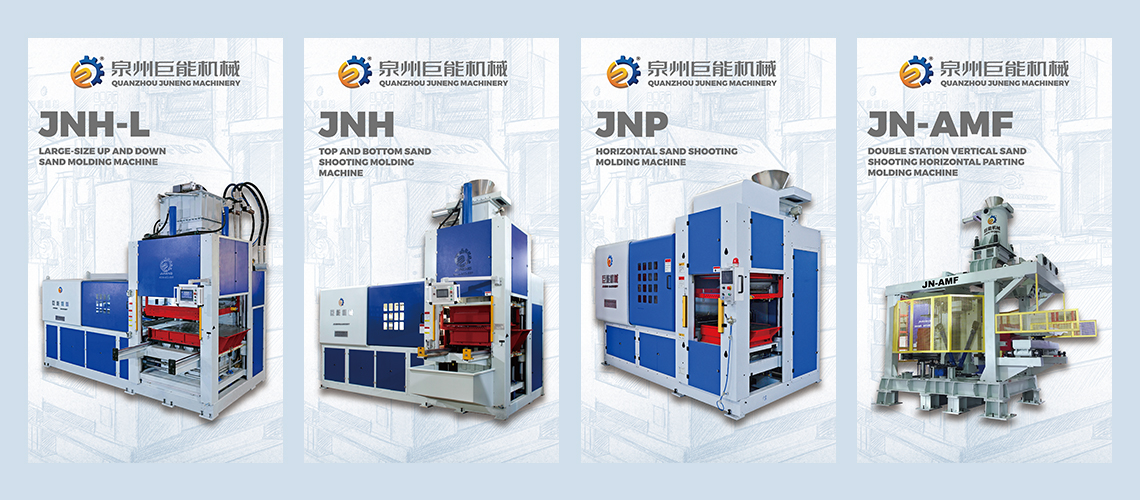
Quanzhou Juneng Machinery Co.,Ltd. is a subsidiary of Shengda Machinery Co.,Ltd. specializing in casting equipment.A high-tech R&D enterprise that has long been engaged in the development and production of casting equipment, automatic molding machines,and casting assembly lines.
If you need a flaskless molding machine, you can contact us through the following contact information:
Sales Manager : zoe
E-mail : zoe@junengmachine.com
Telephone : +86 13030998585
Post time: May-21-2026